Java's optimizer
- java
😇 Thanks to Java's optimizer, you usually don't need to choose between readable vs. fast code.
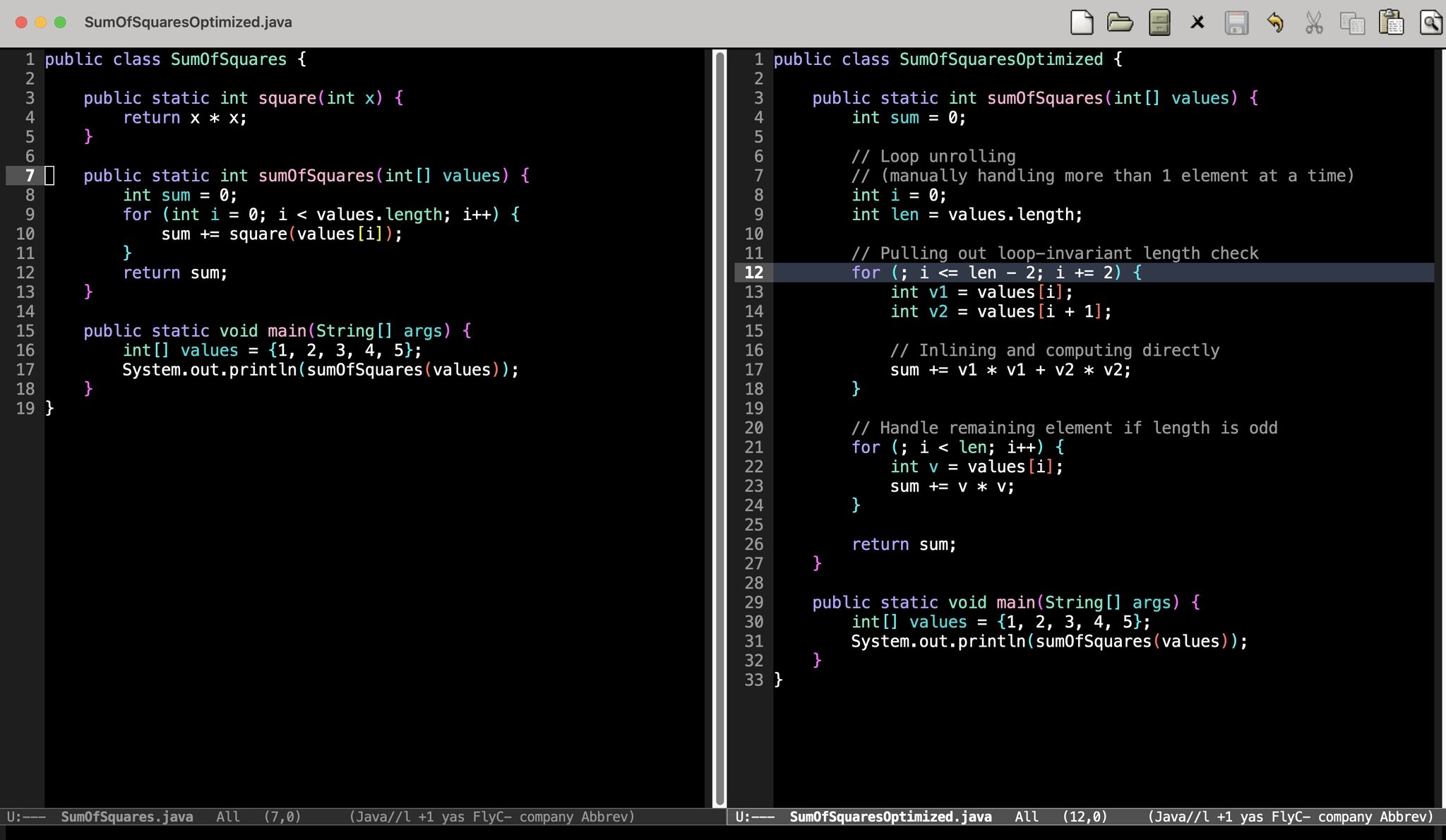
Left on its own, Java will automatically do:
(1) method inlining: replace a method call with the method's body to eliminate call overhead
(2) loop unrolling: duplicates the loop body to reduce the number of iterations
(3) constant hoisting: move expressions that produce the same result on every iteration outside the loop
(4) branch prediction: guess the outcome of conditional branches to avoid stalling
(5) speculative optimization: makes assumptions (like types staying stable) to optimize code
(6) dead code elimination: remove code that has no effect on program behavior
(7) on-stack replacement (OSR): replace currently running interpreted code with natively compiled, optimized code mid-execution
You can see some of this in action in the screenshot. On the left is a clearly written class. On the right is an approximation of how Java will optimize it at runtime.